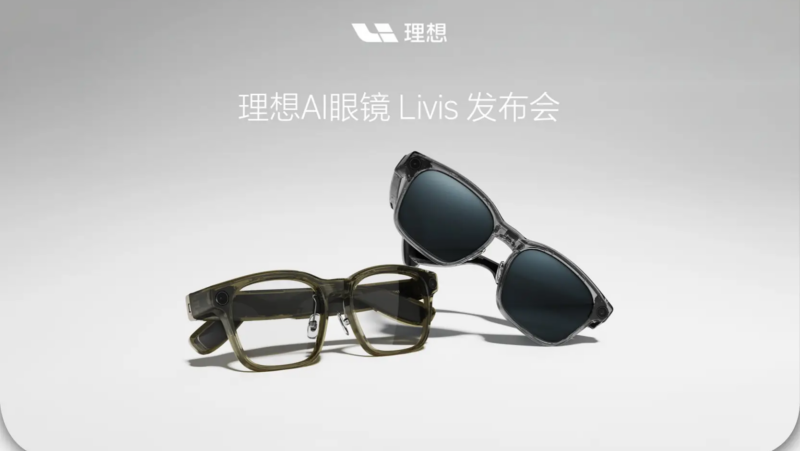
Li Auto launched its first AI smart glasses, Livis, during an online press conference today. Priced starting from 1999 yuan (280 USD). The name Livis is a portmanteau of Li Auto and “Jarvis,” the AI assistant from Iron Man.
Weighing in at 36 grams, Livis claims to be 20% lighter than mainstream AI glasses on the market. The glasses feature a classic Wellington frame style and are available in three colours: classic black, tech grey, and olive green, with options for either glossy or matte finishes.
All Livis models come standard with specially developed Zeiss lenses, supporting convenient online prescription services. These lenses ensure clear visibility of Head-Up Displays (HUD) and enable Face ID unlocking. Furthermore, photochromic (light-sensitive) lenses are available, catering to diverse user visual needs across various scenarios, including prescription, photochromic, and sunglasses.

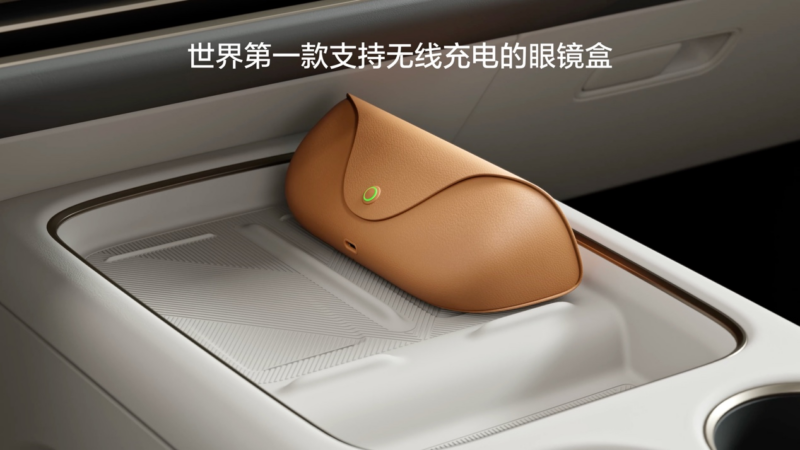
Livis offers a typical usage time of 18.8 hours. The charging experience is enhanced by a standard wireless charging case, akin to AirPods. Additionally, the glasses support wireless fast charging with Li Auto vehicles; users can place them in a dedicated charging slot upon entering the car.
Under the hood, Livis is powered by the Hengxuan BES2800 main control chip and an independent ISP imaging chip. It is equipped with a SONY IMX681 camera, capable of capturing 12-megapixel photos and 4K video with electronic image stabilisation.
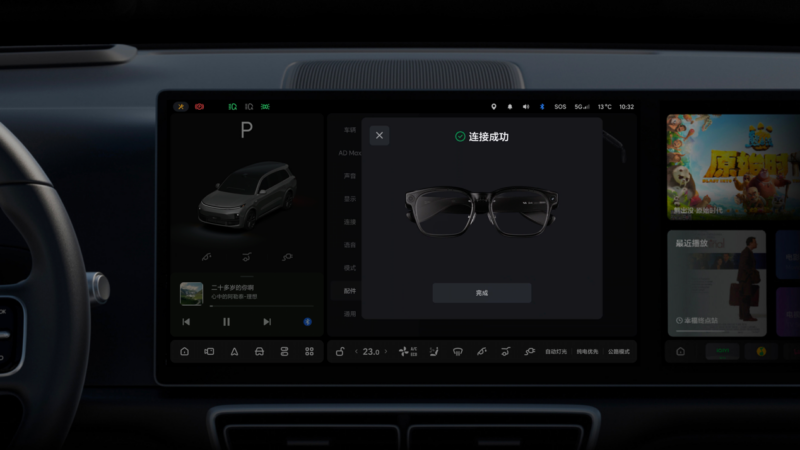
Livis’s most distinctive selling point is its seamless integration with Li Auto vehicles. Leveraging Bluetooth and 5G networks, the glasses connect to the car’s infotainment system, enabling voice-activated remote control. Users can issue voice commands from up to 100 meters away to operate electric sliding doors, pre-activate air conditioning and seat heating, and even check the vehicle’s range and charging status.
Editor’s comment
Even with these glasses, human-vehicle interaction still relies on voice commands. This makes the glasses’ utility questionable, as a driver already has direct voice access to the in-car system without needing the glasses.
Another purported function of these glasses is to control the vehicle within a 100-meter radius. Yet this capability can be entirely replicated by a smartphone, which typically offers a much wider range.
I find myself quite perplexed.