FAW pioneers 142 kWh lithium-manganese liquid‑solid state battery integration, unlocking 1000 km EV range
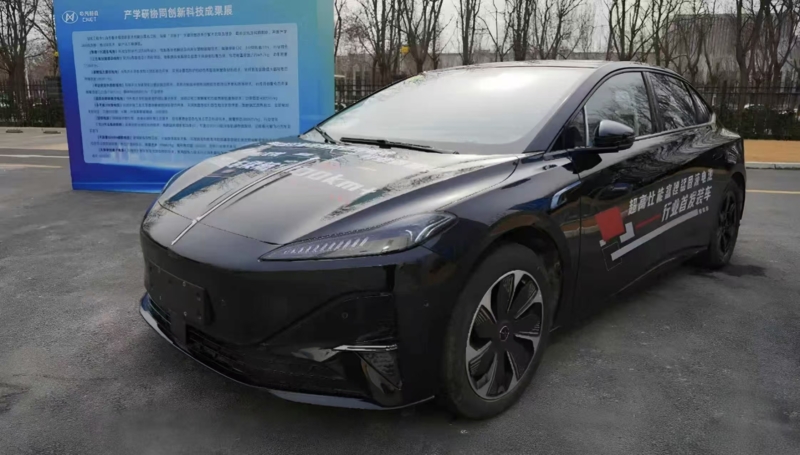
China FAW recently announced the successful integration of its ultra-high-energy lithium-manganese (Li-Mn) liquid-solid-state (semi-solid-state) battery at FAW New Energy Battery Technology Co., Ltd., marking the first-ever installation of this battery type in a production EV. The integration enables a vehicle range exceeding 1000 km, representing a technical benchmark for high-density EV batteries, according to Y-Auto.
The battery was jointly developed by FAW New Energy and the team led by Academician Chen Jun from Nankai University. Chinese media report that the cell-level energy density exceeds 500 Wh/kg. The complete pack delivers 142 kWh, representing a 67% increase in total energy capacity compared with previous-generation packs.
The Li-Mn liquid-solid-state battery employs a hybrid architecture that combines high-energy-density lithium-manganese cells with stabilising solid electrolyte interfaces. This architecture supports both energy density and safety at the pack level. The powertrain and vehicle platform for the initial installation have not been specified, but the integration demonstrates compatibility with FAW’s current EV architecture and long-range segment strategy.
The battery uses in-situ-cured composite electrolyte technology, which provides high ionic conductivity, a wide electrochemical window, strong interfacial compatibility, flame retardancy, and cost advantages. It also incorporates an in situ-formed lithium negative electrode, avoiding the risks and costs of metallic lithium anodes while improving cycle life and safety. The cathode demonstrates a capacity exceeding 300 mAh/g, more than twice that of high-performance LFP cells.
Most semi-solid battery projects currently pursued by automakers are based on modified versions of conventional lithium-ion chemistries rather than entirely new material systems. In China, companies such as Nio, SAIC, GAC, Geely, and Chery primarily rely on high-nickel NCM or NCA cathodes combined with liquid-solid hybrid electrolytes to improve energy density and safety while maintaining compatibility with existing production lines.
Outside China, Toyota, BMW, and Volkswagen-linked projects focus primarily on sulfide-based solid-state technologies built around high-nickel cathodes. Against this backdrop, FAW’s Li-Mn liquid-solid battery represents a less common technical route, shifting the cathode chemistry toward manganese-rich systems rather than nickel-dominant formulations.
Details on variant hierarchy and deployment plans have not been disclosed. Based on the energy metrics, the battery could support both standard- and extended-range configurations across FAW’s mid- to large-size EV lineup. Platform-level adaptations include thermal management systems and power electronics designed to handle the 142 kWh pack’s higher energy throughput.
Pack dimensions and weight have not been released, though the 500 Wh/kg cell-level density suggests a compact design suitable for full-size EVs without major structural modifications. Chinese sources indicate the battery technology could enter mass production in the medium term, though official production timelines remain unconfirmed.
FAW’s battery system is under continued iteration. Sources report that future versions may achieve a pack energy exceeding 200 kWh, a cell-level energy density above 340 Wh/kg, and a potential vehicle range of over 1,600 km. Development includes a five-dimensional thermal-electric-gas-fire protection system and integration with vehicle-cloud coordinated battery management, with demonstration operations planned for 2026.
In the industry context, FAW’s 142 kWh Li-Mn liquid-solid battery is among the first vehicle-level integrations of high-energy-density Li-Mn chemistry. Other automakers in China and abroad are developing solid-state and high-nickel NCM batteries, though few have reported comparable vehicle-level implementation.
Updated: 11/02/2026 13:50 China time