China achieves zero thermal runaway sodium battery, survives 300°C test
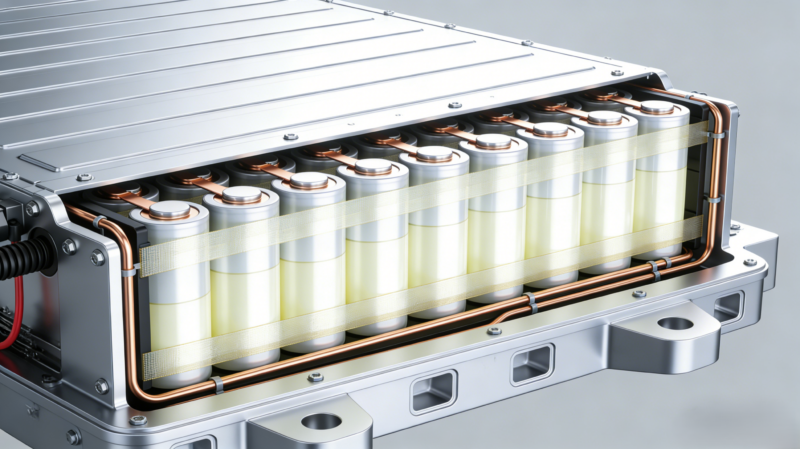
A research team from the Chinese Academy of Sciences has developed a sodium-ion battery that eliminates thermal runaway at the ampere-hour level, IT-Home reported findings published on April 6 in Nature Energy.
Industry push
The team, led by Hu Yongsheng at the Institute of Physics, introduced a polymerisable non-flammable electrolyte (PNE) that enables what it describes as complete suppression of thermal runaway, a key safety risk in battery systems.
Unlike conventional approaches that rely on flame-retardant additives, the system combines thermal stability, interface stability, and physical isolation into a multi-layer protection framework.
How it works
When internal temperatures exceed 150°C, the electrolyte transitions from liquid to a solid-state barrier. This process forms an internal separation layer that blocks heat propagation and prevents chain reactions inside the cell.
The mechanism is designed to stop failure propagation rather than only delay ignition, addressing a limitation in traditional battery safety strategies.
Validation results
The technology was validated in a 3.5 Ah cylindrical sodium-ion cell. Testing showed no smoke, fire, or explosion during nail penetration, and no thermal runaway even at temperatures up to 300°C.
These results indicate full interruption of thermal runaway pathways under extreme conditions.
Performance retained
The safety improvement does not appear to reduce battery performance. The cell operates across a temperature range from -40°C to 60°C and maintains stability at voltages above 4.3 V.
The energy density reached 211 Wh/kg at the cell level, according to reported data.
Scaling up
The research is linked to Zhongke Haina (HiNa), a sodium-ion battery developer spun out of the same institute.
Recent industry disclosures indicate sodium-ion batteries are moving toward commercial deployment. According to Hina, heavy truck testing showed around 15% lower energy consumption per kilometre and roughly 20% longer range under typical conditions, with early-stage commercial use already underway.
Industry relevance
Cost dynamics remain a key factor. HiNa expects sodium-ion batteries to reach cost parity with lithium-ion systems around 2027, with overlapping price ranges by 2028 as production scales.
Parallel developments from automakers highlight broader momentum. BAIC has disclosed a sodium-ion battery capable of full charging in about 11 minutes, alongside stable operation across -40°C to 60°C and resistance to high-temperature abuse conditions.