1300°C battery “firewall” unveiled as China accelerates EV safety push, report says

A research team from Nanjing Tech University has developed a lithium battery insulation material capable of withstanding temperatures up to 1300°C, according to Science and Technology Daily.
Narrowing safety gap
The material is a silica aerogel-based insulation sheet designed to slow heat transfer between lithium-ion battery cells during thermal runaway events. In such cases, cell temperatures can rise sharply within seconds and spread across adjacent cells.
In testing, a 2.3 mm sheet exposed to 1000°C for five minutes kept the opposite side below 100°C. The material can maintain thermal isolation for up to two hours. Earlier battery aerogel solutions typically operated at around 300°C, below the 650°C-1000°C range observed in cell combustion. The new version increases tolerance from 650°C to 1300°C.
Scaling material performance
Aerogel’s structure consists of a nanoporous network that is approximately 99% air, limiting heat conduction. The research team improved thermal resistance by reinforcing this structure and adjusting catalyst conditions during synthesis.
To address brittleness, the material was engineered to achieve over 90% elastic compression while maintaining structural stability. This aligns with battery operation, where cells expand and contract repeatedly.
Manufacturing improvements
Production challenges were addressed using an optimised supercritical CO₂ drying process. Efficiency improvements included solvent recovery, with ethanol reuse exceeding 99.5%, reducing raw material costs by more than half.
These process changes enabled scaling from laboratory development to industrial production.
Industry push
The aerogel material is already used in battery systems from CATL, BYD, Sungrow, and Xiaomi. Beyond EVs, applications include aerospace and high-temperature industrial environments.
The development comes alongside broader advances in battery technology. Recent industry shifts include sodium-ion batteries transitioning to lower-cost, longer-life cathode chemistries, while GWM’s Svolt has started mass production of an 80 kWh PHEV battery, among the largest announced for plug-in hybrids.
Policy backdrop
China’s “15th Five-Year Plan” identifies advanced materials and new energy as strategic sectors. Aerogel insulation is positioned to move from a high-end optional component toward wider adoption in battery systems.
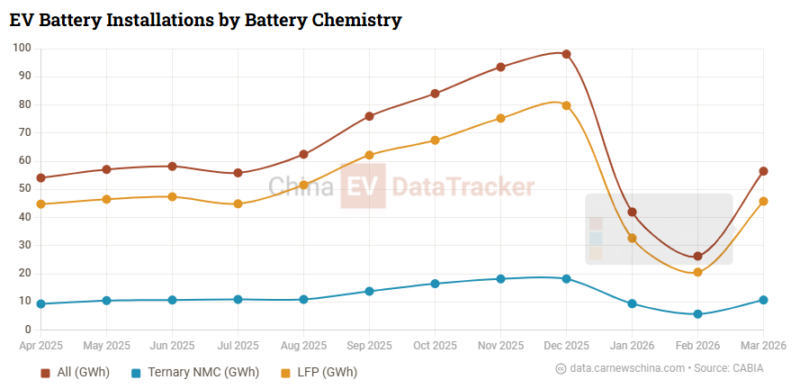
Data context
China’s battery installation data shows continued dominance of lithium iron phosphate (LFP) chemistry, according to China EV DataTracker. In March 2026, total installations reached 56.5 GWh, with LFP accounting for 45.8 GWh, or 81.1% share, while ternary NMC contributed 10.7 GWh with 7.0% year-on-year growth. Overall installations were broadly flat year-on-year at -0.2%, reflecting stable demand while chemistry mix continues to favour LFP.