CATL’s battery-swap stations to feature Shenxing Supercharging with 6-minute full charge capability
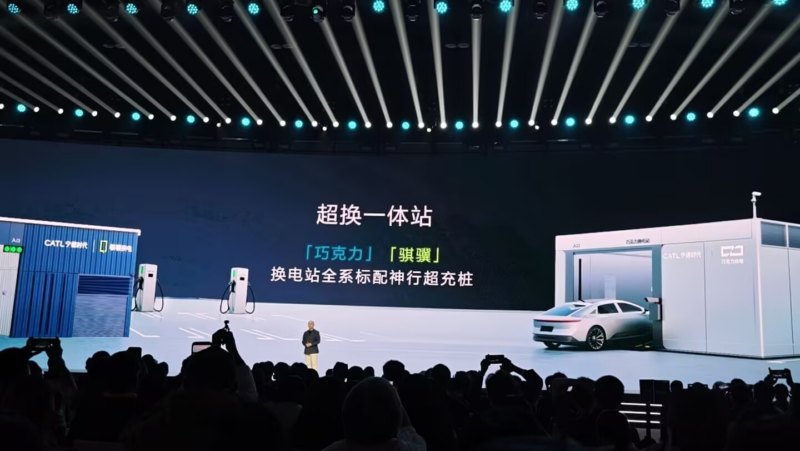
Today, during its CATL Tech Day event, CATL officially launched its integrated Supercharging and Battery swapping Network, announcing that all its Chocolate (for passenger cars) and Qiji (for heavy trucks) battery swap stations will now come standard with Shenxing supercharging piles, upgrading them to integrated “Supercharging&Swap” stations.
Current footprint and technical advantages
To date, CATL has built 1,470 Chocolate battery swap stations across 99 cities. The company highlighted two core advantages of the integrated solution: energy conversion efficiency and grid compatibility.
In terms of energy conversion efficiency, battery swapping requires only one energy conversion – from grid to swap battery to vehicle – resulting in a single power loss. In contrast, current storage-equipped charging solutions on the market require energy to pass through two intermediate stages: from the grid to the storage battery, then discharged to the vehicle battery, resulting in two power losses.
The integrated solution reduces power loss rates by more than 13 percentage points compared to storage-equipped ultra-fast charging solutions by sharing box transformers and charging modules.
CATL calculated that for every 100 kWh output from the grid, the integrated solution can deliver 13 kWh more to vehicles compared to storage-based solutions. Depending on vehicle energy consumption, this translates to an additional driving range of 65 to 120 km.
New revenue opportunities for vehicle owners
CATL revealed that starting in the second half of this year, Chocolate battery swap users will be able to exchange fully charged battery packs at swap stations during peak electricity pricing periods. The stations will pay the price difference to car owners, with daily earnings potentially reaching 40 yuan (6 USD). This could cover battery lease costs. CATL described this innovation as: “Previously, charging and swapping cost money, now you can earn from swap stations.”
Hardware upgrades: New chocolate 26# battery
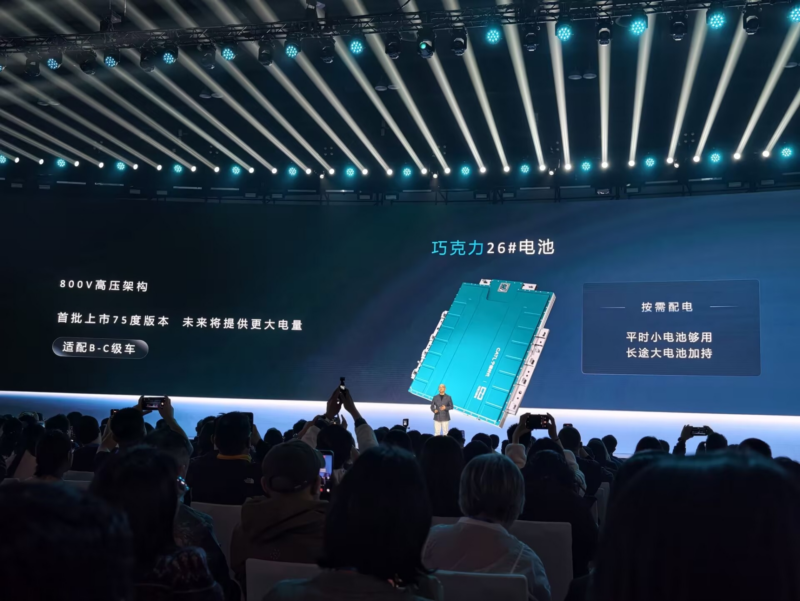
Supporting the integrated solution, CATL launched the Chocolate 26# swap battery, built on an 800V high-voltage architecture. The first available version is a 75 kWh unit, with larger capacity versions planned for the future, suitable for both B-segment and C-segment vehicles.
The core philosophy of Chocolate battery swapping is “on-demand power allocation” – users can use smaller batteries for daily driving and swap to larger batteries for long-distance travel, avoiding the lifetime cost burden of carrying a large battery for occasional long trips. Lease users enjoy a lifetime warranty and lifetime upgrades, eliminating concerns about battery degradation and used car depreciation.
Expansion plans and partnerships
CATL plans to offer two station types: standard integrated swap-charge stations and 4S dealership experience stations, flexibly adapting to urban core areas, highway corridors, and test-drive scenarios.
Regarding network construction, CATL plans to build a cumulative 4,000 integrated swap-charge stations by the end of 2026, covering 190 cities nationwide and a “12 vertical, 11 horizontal” highway network, achieving seamless urban and intercity charging coverage.
First-batch partners include Changan, Chery, GAC, Seres, SAIC-GM-Wuling, and BAIC. By 2028, CATL aims to establish over 100,000 shared charging infrastructure facilities.
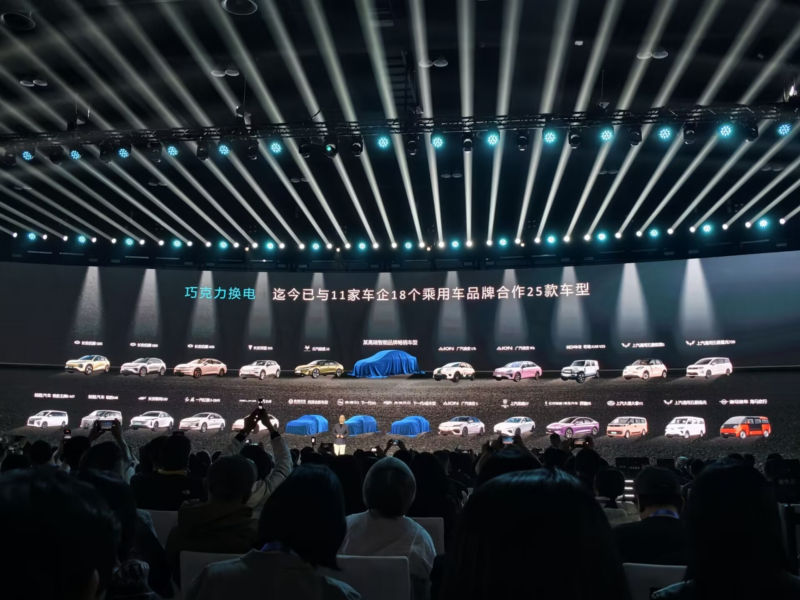
To date, CATL has established battery swap partnerships with 11 automakers, 18 passenger vehicle brands, and 25 vehicle models.
Editor’s comment
At tonight’s event, CATL rolled out four batteries in one go: the third-gen Shenxing, the third-gen Qilin, the second-gen Freevoy, and the sodium-ion battery, Naxtra, which is set for mass production in Q4.
Both the third-gen Shenxing and third-gen Qilin support fast charging that’s even quicker than BYD’s second-gen Blade battery. So, here’s the question: where do you charge them? Here’s the answer: charge them at the Shenxing Supercharging piles that come standard at Chocolate battery swap stations.
BYD achieves its flash charging through energy storage batteries, whereas a Choco SEB station is naturally an energy storage station itself.