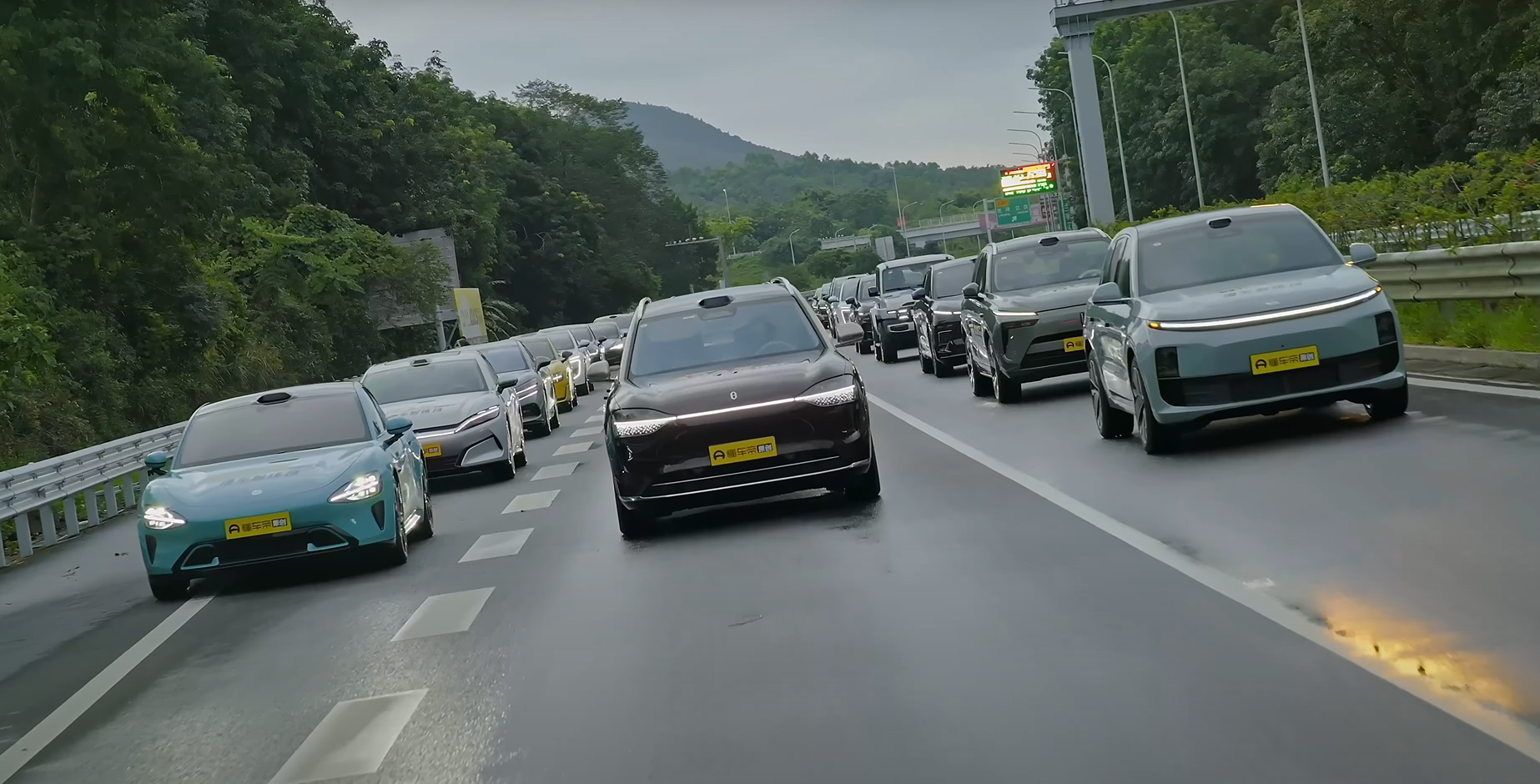
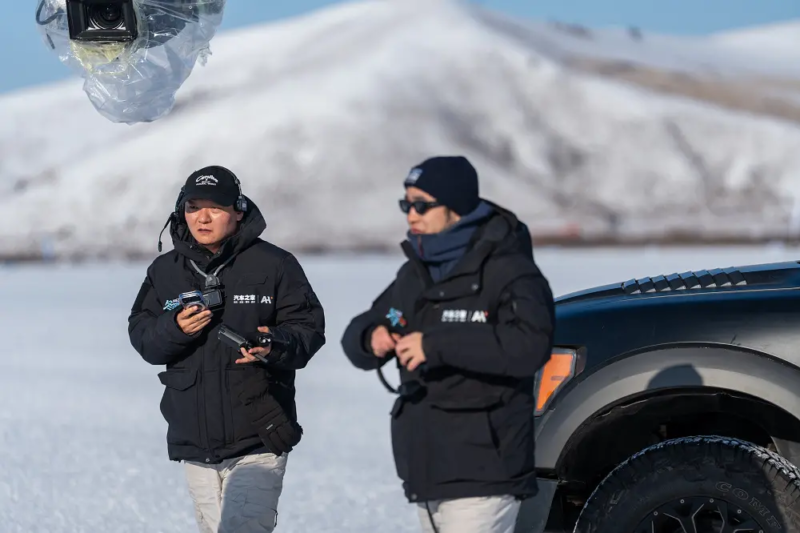
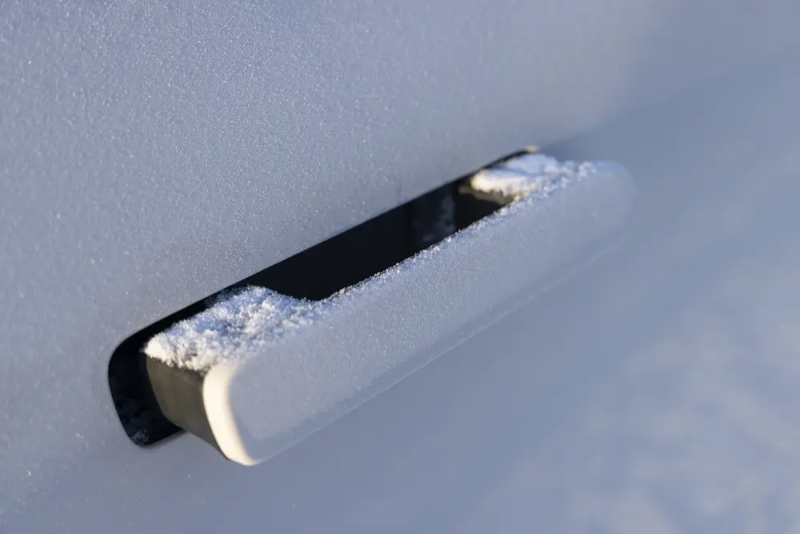
China’s largest automotive outlet, Autohome, published the results of its 2025 winter testing, which took place in Yakeshi, Inner Mongolia. Testing was conducted at temperatures between -10°C and -25°C, and seven scenarios were evaluated: range, consumption, fast charging, air conditioning, AEB, acceleration, and off-road capabilities.
It is the most extensive winter testing Autohome has ever performed, even setting a Guinness World Record, as their officials confirmed as “the largest-scale field winter car test”, testing 67 cars simultaneously. Guinness World Records neither evaluated test results nor endorsed any particular vehicle model. It only confirmed whether the scale is genuine and the test results are verifiable.
The winter test covered small hatchbacks, sedans, and SUVs across all price ranges, from 60,000 yuan to over 2 million yuan.
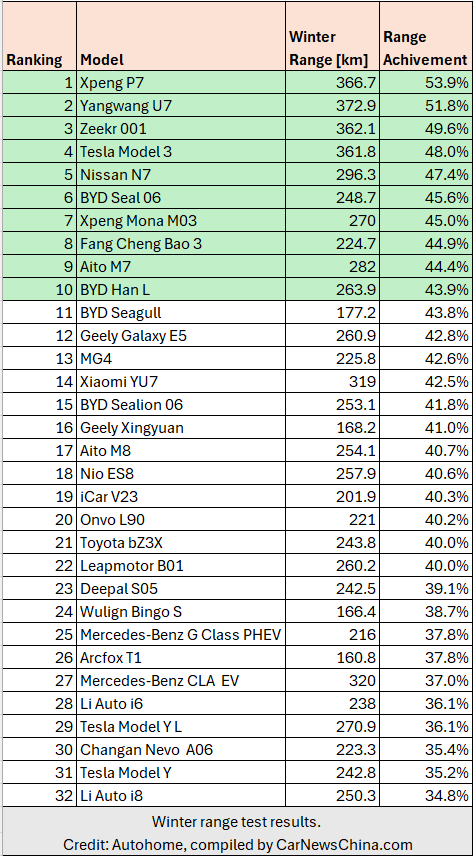
In the winter range test, Xpeng P7 (AWD) was the winner with a 53.9% range achievement rate, followed by BYD’s Yangwang U7 (AWD) with 51.8% and Zeekr 001 (AWD) with 49.6% in third place. The Tesla Model Y (AWD) ranked 31st at 35.2%, and the lowest score went to the Li Auto i8 (AWD) at 34.8%. The remaining cars tested were PHEVs. It’s worth noting that Autohome’s founder, Li Xiang, is also the CEO and founder of Li Auto.
Here is the full leaderboard for the winter range test results:
Another interesting test scenario was measuring energy consumption per 100 km. No wonder this discipline was dominated by small hatchbacks, with BYD Seagull (FWD) being the winner with 23.5 kWh per 100 km, followed by Geely Xingyuan (RWD) with nearly the same result. The third spot went to BYD Seal 06 (RWD).
The Xiaomi YU7 SUV ranked 20th with 33.7 kWh of consumption, while its competitor, the Tesla Model Y, was right behind at 34.9 kWh.
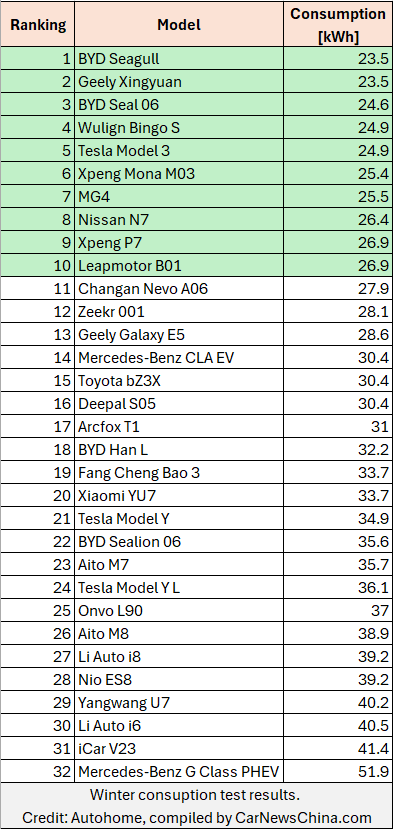
Testing was conducted at temperatures between -10°C and -25°C.
The fast charging in extreme cold conditions was measured from 30% to 80%. The surprise winner was Avatr 06, which needed only 15 minutes; it was followed by Nevo 06 and Fulwin A9L, an EREV. The Xiaomi YU7 SUV ranked 39th at 31 minutes, while the Model Y ranked 44th at 35 minutes.
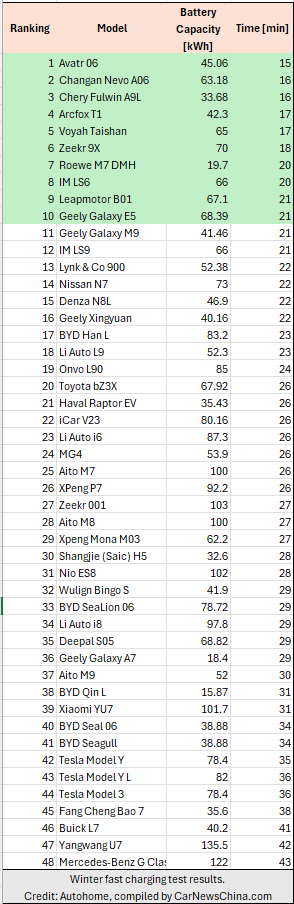
Testing was conducted at temperatures between -10°C and -25°C.
Interestingly, the Xiaomi SU7 sedan didn’t participate in the winter test. While we can compare the Xiaomi YU7 and Model Y’s performance, we can only estimate how the SU7 would perform against the Model 3, which performed exceptionally well in most scenarios.
You can watch the full winter testing video here [in Chinese].