China 2025 hydrogen vehicle report: fleet around 30,000, core components 70 percent localized
China’s Hydrogen Fuel Cell Vehicle Industrialization Development Report (2025), released at a national strategy seminar in Hefei, provides a detailed assessment of the country’s hydrogen fuel cell vehicle industry. The report covers production and sales trends, core component localization, cost composition, and deployment of hydrogen refueling infrastructure, highlighting China’s substantial commercial hydrogen vehicle fleet alongside persistent technical and operational challenges.
Academician Yi Baolian of the Chinese Academy of Engineering noted that core component localization exceeded 70 percent in 2025, reflecting expanded domestic manufacturing capacity for fuel cell stacks and related systems. He also emphasized ongoing challenges in cost, material durability, and uneven hydrogen refueling infrastructure. Deputy Secretary-General Yang Zhongping highlighted hydrogen energy’s role in achieving China’s dual-carbon goals and acknowledged progress during the 14th Five-Year Plan period while noting continuing technology, cost, and infrastructure constraints.
According to data from the China Association of Automobile Manufacturers and external analyses, cumulative hydrogen fuel cell vehicle production in 2024 reached 5,548 units, with sales of 5,405 units. Early 2025 figures show 1,364 units produced and 1,373 sold in the first half of the year, down roughly 47 percent year over year. The national fleet stood at approximately 30,000 vehicles, below a previously stated target of 50,000 units, highlighting ongoing challenges in scaling manufacturing and market adoption.
The seminar featured presentations from multiple automakers and component suppliers. BAIC Foton Vice President Zhang Jinggui discussed the deployment of commercial hydrogen fuel cell vehicles, technical evolution, and operational experience on freight and logistics lines. Qingling Motors Deputy General Manager Ma Chongshan outlined the company’s hydrogen product development, multi-scenario applications, and market promotion strategies. Xiamen King Long Vice President Su Liang detailed fuel cell bus development, market adoption, and industrialization pathways. Anhui Tomorrow Hydrogen, Shanghai Jiechuan Technology, and YAPP Automotive Components presented on hydrogen energy strategies, industrialization progress, and the development of hydrogen production, storage, transport, and refueling systems.
Operational demonstration programs cited in the report include more than 200 hydrogen fuel cell vehicles operating across more than 20 major freight corridors, supported by more than 40 hydrogen refueling stations. Most stations operate at 35 MPa, which meets commercial vehicle requirements. National hydrogen supply capacity was approximately 327,000 kilograms per day in mid-2025, with average urban hydrogen prices at around 26.7 yuan per kilogram and overall production costs declining from 30.2 to 27.7 yuan per kilogram year-on-year.
The report also includes technical and cost analyses for heavy-duty fuel cell vehicles. In 49-ton class models, the fuel cell system accounts for about 53 percent of total vehicle cost, and the hydrogen storage system accounts for approximately 14 percent, meaning these components together exceed two-thirds of the vehicle’s cost base. Projected technological improvements and scale production are expected to reduce fuel cell system costs by more than 40 percent by 2027.
A high-level panel discussed scaling production, industrial chain coordination, policy optimization, business model innovation, and key technology breakthroughs. Chief Engineer Ye Shengji noted that product upgrades, cost reductions, expanded application scenarios, end-to-end coordination, and balanced infrastructure development are critical to advancing the industrialization of hydrogen fuel cell vehicles.
The report and seminar provide a comprehensive platform for knowledge exchange, reinforcing industry consensus on strategic priorities and technological development pathways to accelerate the deployment of hydrogen fuel cell vehicles in China.
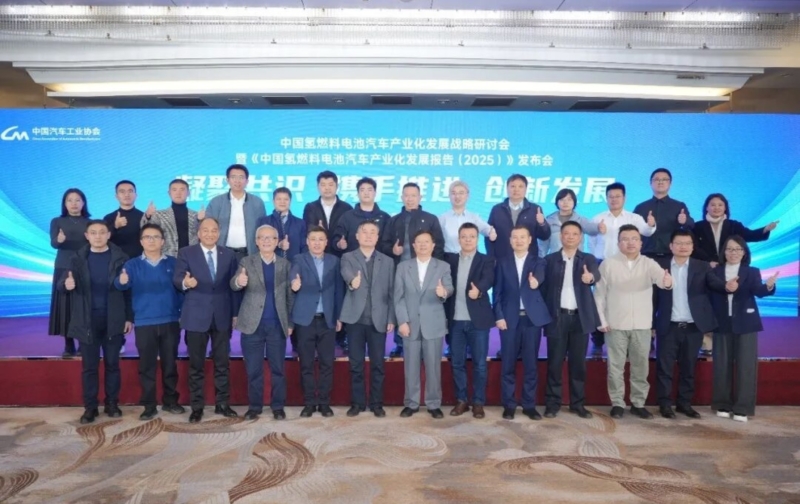
The China Association of Automobile Manufacturers is releasing a 2025 hydrogen vehicle report.