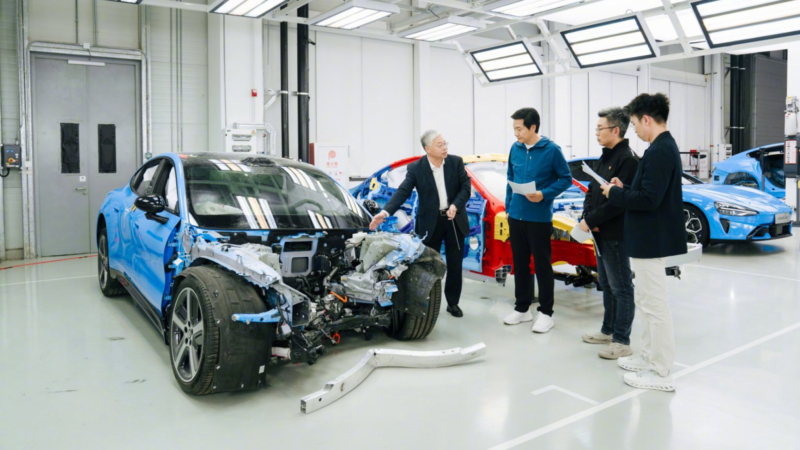
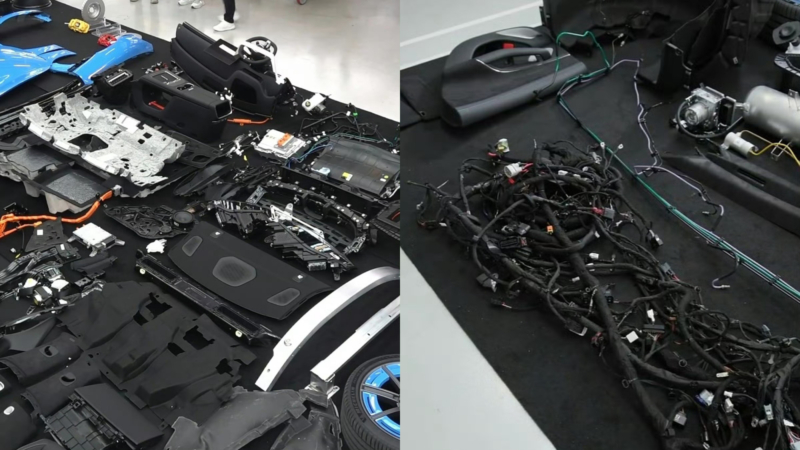
The new 2026 model year Xiaomi SU7 electric sedan’s live teardown was held in China by the company CEO Lei Jun. He examined the car’s exterior, interior, electric systems, safety, and chassis. The broadcast lasted for 3.5 hours as the SU7 was disassembled to the component level.
Lei Jun invited a car safety expert, Zhu Xichan, to join him in the teardown process of the new SU7 Pro sedan. It is the mid-trim EV with rear-wheel drive, a 96.3 kWh LFP battery, air suspension, and a price tag of 249,900 yuan (36,290 USD). Previously, Lei Jun held a teardown of the Xiaomi YU7 crossover.
Exterior components
Lei Jun started with the SU7’s paint. The car’s body adopts the 3C2B technology, which means “three coats and two baking processes.” Under the paint, the body is protected from corrosion by the use of galvanized steel, pretreatment, and electrophoresis. The first paint coat is an intermediate layer. It provides a uniform base coat, fills in defects, and determines the final texture. It also reportedly improves stone chip resistance.
The first paint color is baked at 160 °C for 20 minutes to enhance paint protection. The second paint layer determines the color. It is flash-dried to evaporate solvents and moisture. The third is a clear coat that protects the color layer. It is applied twice to provide better gloss. It is baked at 140 °C for 20 minutes to enhance the scratch resistance.
Rims of the new Xiaomi SU7 Pro sedan were created with the milling process. Its shape was milled for 13 hours with 22 different cutting tools. The front bumper of the car integrates a new 4D mm-wave radar and an adjustable active air filter. It is worth noting that the top-trim SU7 Max has unique air ducts on both sides to keep the brakes cool.
Headlights of the new Xiaomi SU7 have four light modules with a copper substrate and cylindrical heat sinks with a larger heat dissipation area. Another highlight is the active air cooling system with one fan and two 90° air ducts. The taillight unit features a spray-painted and laser-etched three-layer finish. It comprises 360 LED units placed 10 mm apart.

Side-view mirrors of the new SU7 integrate surround-view cameras with lens coverage of 90.7%. It features blind spot warning and a heated layer in the back of the lens. Notably, the Max trim level has an anti-glare electrochromic (EC) function.
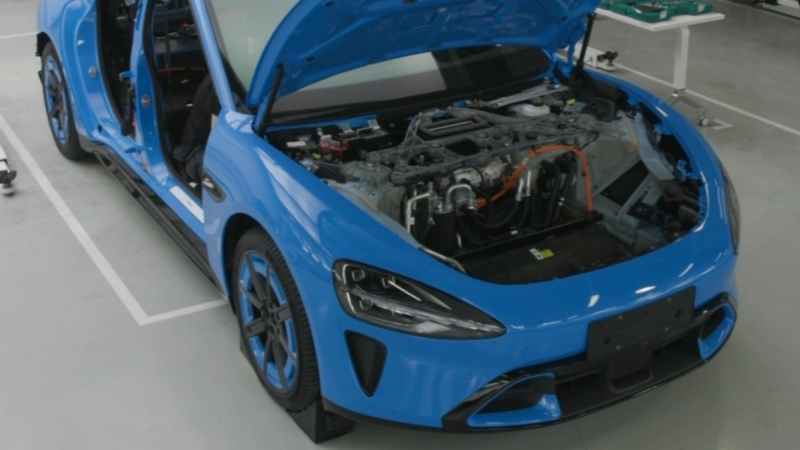
The next-gen Xiaomi SU7 adopts a power front trunk. It could be electrically opened via voice command from the cabin, external physical buttons, and the UWB control. The trunk has a capacity of 105 liters. The final feature of the SU7’s exterior is the slanted radiator that saves space compared to a vertical arrangement. It has an integrated die-cast aluminum triangular beam, a refrigerant module, a compressor, a PTC, and a water circuit module.
Interior components and electronics
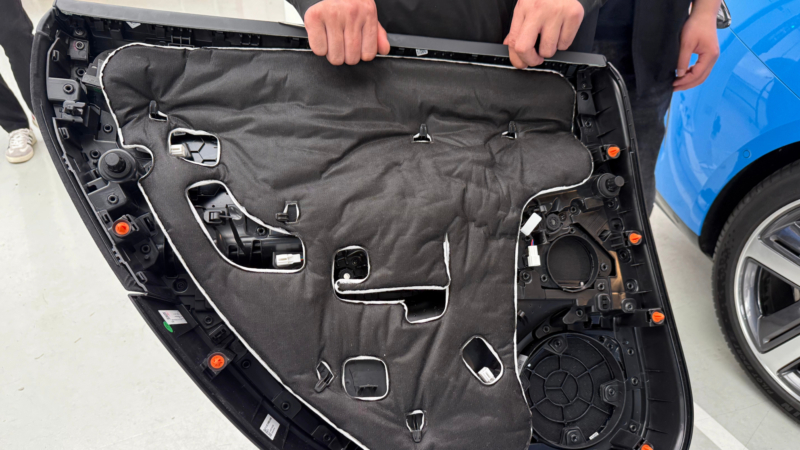
The new Xiaomi SU7 has an upgraded refrigerator compressor and a storage space of 18.4 liters under the center tunnel. Xiaomi upgraded door speakers with a metal mesh to improve sound transmission. The sound system consists of 25 speakers. There is also a 3-module 8-microphone array in the cabin, which supports five-zone voice control. Sound insulation cotton covers over 90% of the door panels. The driver’s seat has 18-way power adjustment and a seven-layer material.
The new SU7 adopts the four-in-one domain control module. It integrates cockpit, driver assistance, vehicle control, and communication modules into one unit, reducing weight. There are also four main controllers, responsible for body control, thermal management, loads related to the left of the car, and loads related to the right of the car. The SU7 adopts electronic fuses with fast power-off execution. The Xiaomi SU7 is equipped with a LiDAR sensor, a 4D millimeter-wave radar, 12 ultrasonic sensors, and 11 cameras.
Chassis & safety
The Xiaomi SU7 adopts the front double wishbone and the rear five-link structure. Such a suspension reportedly helps the car to maintain four-wheel grip during braking or cornering. All SU7 trim levels come standard with 265 mm rear tires. Closed-loop double-chamber air springs and a continuous damping system allow adjusting the suspension height and stiffness in real time.
The Xiaomi SU7 comes standard with four-piston fixed front brake calipers. This structure helps to slightly reduce the drag torque and increase the CLTC range by 3 km. The SU7 Max adopts four-piston Brembo brake calipers and ventilated brake discs.
The Xiaomi SU7’s body-in-white adopts the 7-series aerospace-grade aluminum front bumper beam with a width of 1,490 mm. It covers 79% of the car and boasts 280-mm deformable energy-absorbing boxes. The new SU7 uses 90.3% high-strength steel and aluminum alloy, including steel with a 2,200 MPa stiffness. The latter is applied to the four-door beams, A-pillars, and C-pillars.
The front bulkhead uses 1,500 and 2,000 MPa reinforcing plates. The car’s rear floor adopts a three-section design. It is good for the post-collision repair as only damaged parts need to be replaced, not the entire die-cast rear floor. The new SU7 comes standard with nine airbags, including two additional rear side airbags. It also features integrated woven side curtain airbags. The car’s battery is protected by a frame with two 1,500 MPa steel crossbeams and two 2,000 MPa steel floor crossbeams at the top.
Lei Jun and Zhu Xichan examined the SU7 that underwent a 50% offset collision at a speed of 60 km/h. They highlighted the energy absorption in the front crumple zone and clear deformation of the front bumper beam, without tearing. The A-pilla didn’t deform.
Briefly about the new Xiaomi SU7
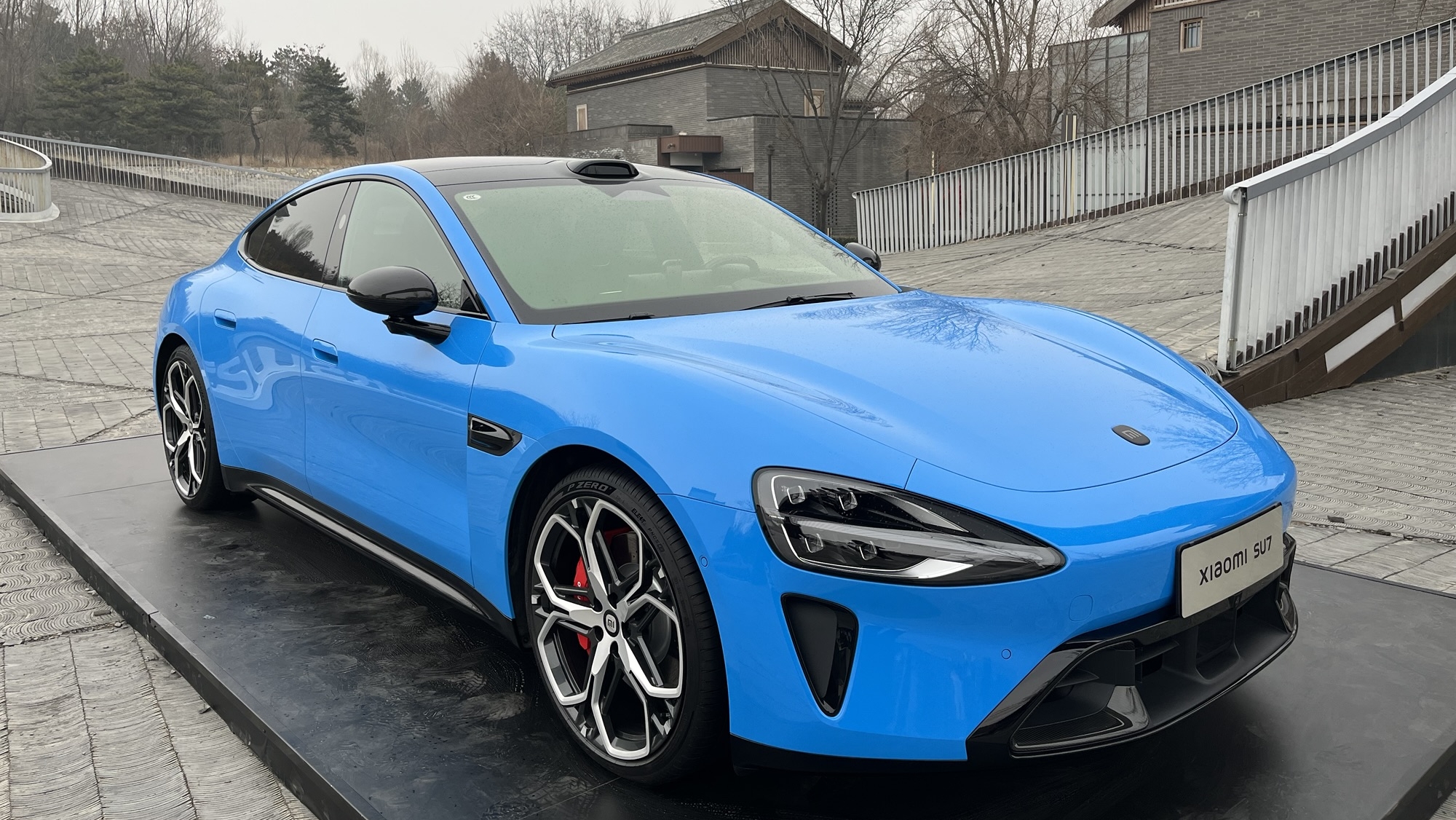
The new Xiaomi SU7 is a sizeable electric sedan with dimensions of 4997/1963/1445 mm with a wheelbase of 3,000 mm. It entered the domestic market on March 19, receiving 40,000 firm orders.
The Standard and Pro trim levels of the car come standard with a 235 kW (315 hp) e-motor in the rear axle. The AWD variant offers a dual-motor AWD for 508 kW (681 hp). Three battery options are available, including a 73 kWh LFP pack, a 96.3 kWh LFP pack, and a 101.7 kWh ternary NMC pack. The range lies between 720 and 902 km under CLTC conditions.