New BYD Han EV sedan arrives at China dealers with flash charging and Blade Battery 2.0
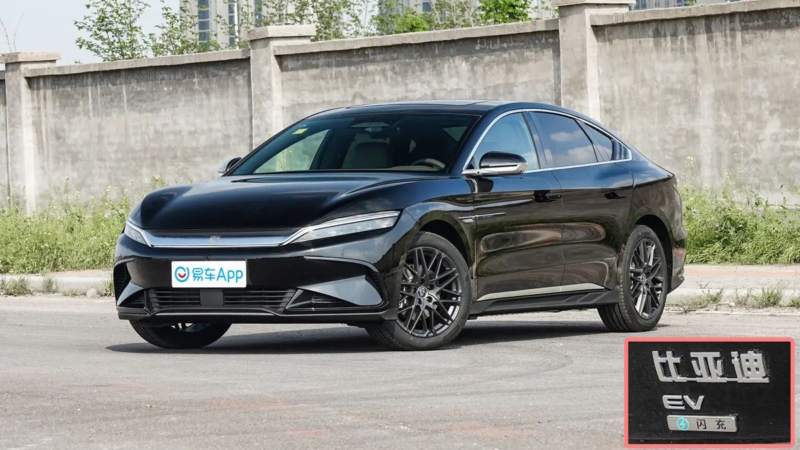
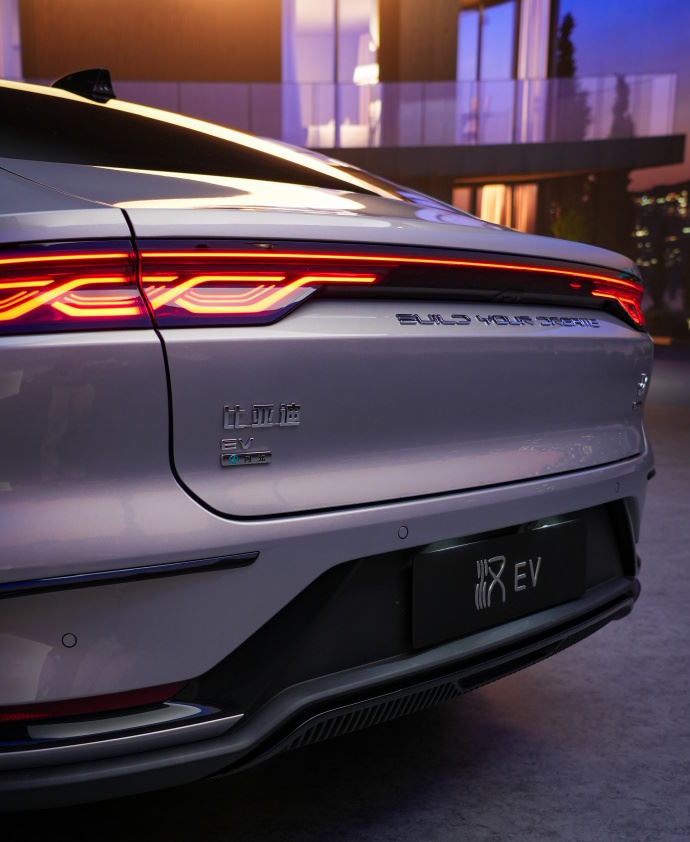
BYD has launched a revised trim of the Han EV sedan featuring the firm’s latest Blade 2.0 battery and flash charging technology. While pricing has not been announced, the new Han EV is arriving at dealers across China, with sales expected to begin shortly.
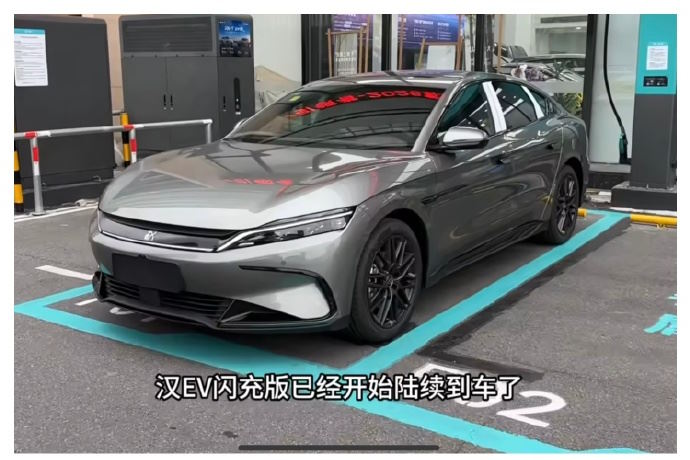
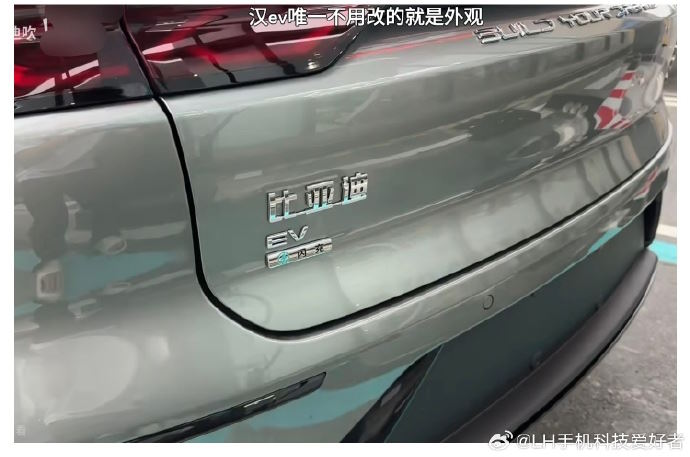
The refreshed BYD Han EV sedan, not to be confused with its bigger sibling, the Han L, keeps its styling and interior unchanged, in line with the current Han. The main focus of this refresh is on the new 69.07 kWh Blade 2.0 LFP battery pack, delivering a CLTC range of 705 km and giving the Han EV flash charging capabilities. BYD claims that the new Han EV will be able to deliver on its flash charging mantra:
- 5 minutes from 10% to 70%
- 9 minutes from 10% to 97%
- Only 3 minutes slower at -30°C
Taking the 9-minute figure, this translates to an average charging power of 400 kW from 10% to 97%. Real-world peak power will be much higher, since the charger has to slow down as the state-of-charge (SoC) goes beyond 80 % and the process nears completion.
BYD’s DiPilot (God’s Eye) driver-assistance system comes as standard on the revised Han EV, but LiDAR is absent on this model. Existing Han sedans, both EV and PHEV trims, come with DiPilot 100 (God’s Eye-C) and DiPilot 300 (God’s Eye-B), with “100” systems being vision-based, and “300” systems working with a roof-mounted LiDAR unit. BYD has not specified the variant of the DiPilot system on the revised Han EV, but considering the lack of LiDAR, it should be similar to DiPilot 100.
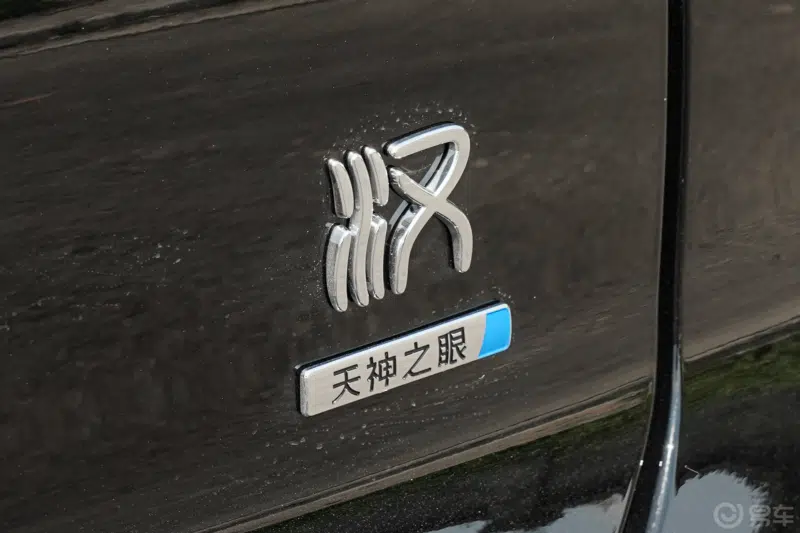
For reference, the existing Han sedan measures 4995 mm in length, 1910 mm in width, 1495 mm in height, and a 2920 mm wheelbase. Current EV trims can be optioned with 150 kW (201 hp), 168 kW (225 hp), and 170 kW (228 hp) on the front axle, and only front-wheel drive (FWD) is available.
The current Han weighs 1920 – 2000 kg, depending on trim, and all trims use front McPherson struts and rear 5-arm multilink suspension. All EV trims come standard with active suspension with adjustable firmness, while electromagnetic suspension is an optional extra.
While pricing for the refreshed Han EV has not been announced, it is expected to be around 200,000 yuan (29,400 USD). For reference, the existing Han EV lineup retails at 179,800 to 218,800 yuan (26,400 to 32,100 USD).
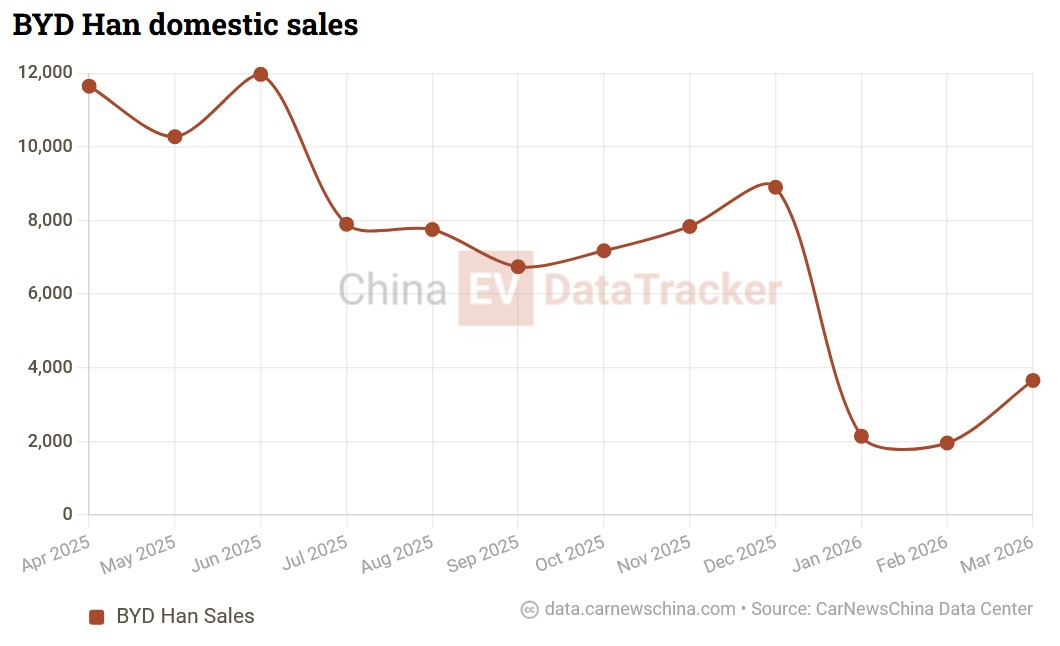
According to China EV DataTracker, 3,661 units of the BYD Han EV were delivered domestically in March 2026. This marks a significant slump from its peak in June 2025, and indicates that current Han models are becoming non-competitive in China’s brutal EV market. This refresh may enable the Han EV to gain a new lease of life, and give consumers an extra reason to consider it over rivals like the Lynk & Co 10, Xpeng P7+ or the Toyota bZ7.
More on BYD and Flash Charging
With BYD’s flash charging making waves in China’s auto industry and piquing consumer interest, the firm is gradually refreshing its existing lineup with the Blade 2.0 battery and flash charging capability. In April alone, BYD has launched flash-charging editions of the Denza N8L, Atto 3 (Yuan Plus) and Seal 06 GT, even bringing it to PHEV models like the Seal 06 DM-i wagon.
The firm’s rivals have certainly taken notice too. Geely‘s Lync & Co sub-brand has attempted to one-up BYD with its 900V Energee Golden Brick battery, claiming that a 10% to 97% charge on a Lync & Co 10 only takes 8 minutes and 42 seconds, 18 seconds faster than BYD’s system. A Zeekr V4 megawatt charger was used, but Geely has not disclosed any rollout timelines for this system.
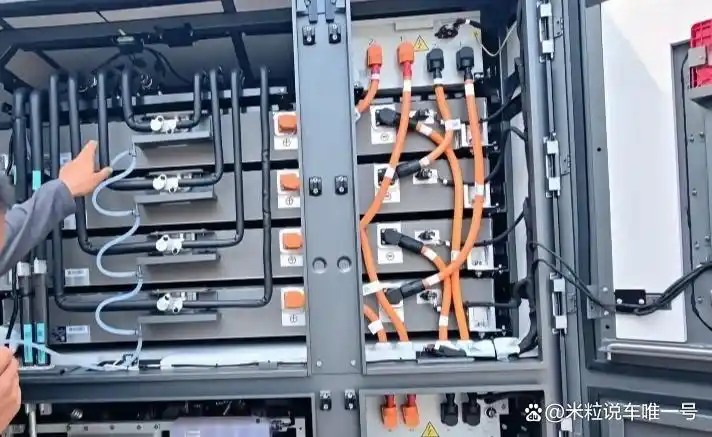
Meanwhile, BYD installed its 5,000th megawatt flash charger earlier in April, and has committed to building 20,000 chargers by the end of 2026. BYD’s flash chargers are equipped with four Blade batteries to act as power grid buffers, with a total capacity of 169 or 185 kWh. The firm claims that the chargers only nominally require 100 kW from the grid, filling up the buffer batteries during charger downtime.
If these plans are realized, BYD’s flash charging network will significantly overshadow NIO‘s and CATL‘s battery swapping ecosystem, giving it a definitive edge in the Chinese EV infrastructure race.


