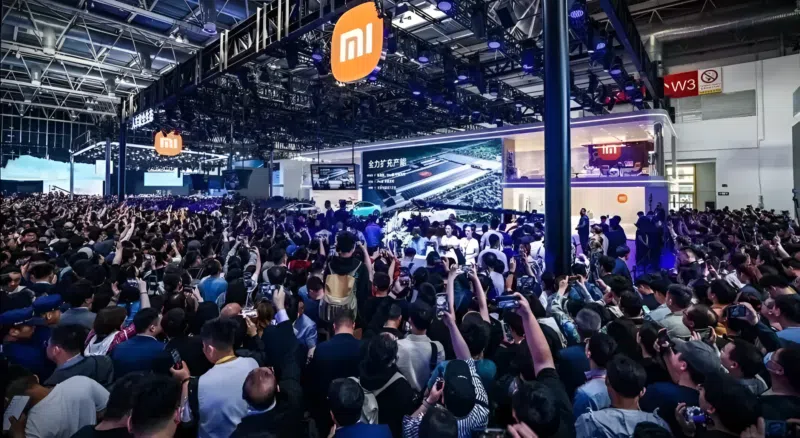
The official floor plan for the 2026 Beijing International Auto Show has been released ahead of its April 24 opening, confirming a total exhibition area of 380,000 square meters, making it the largest auto show globally, Autohome reports.
Dual-venue expansion
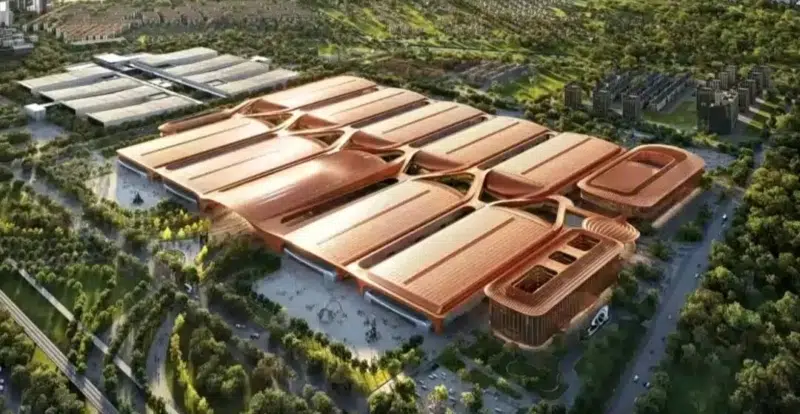
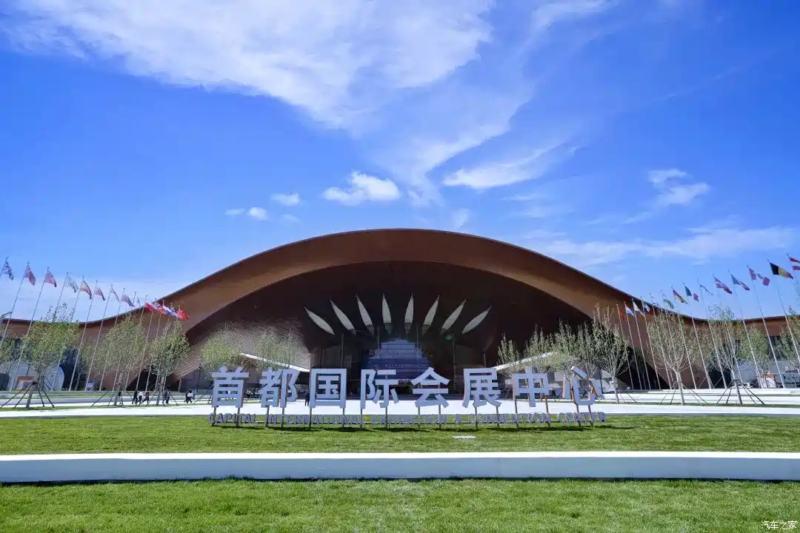
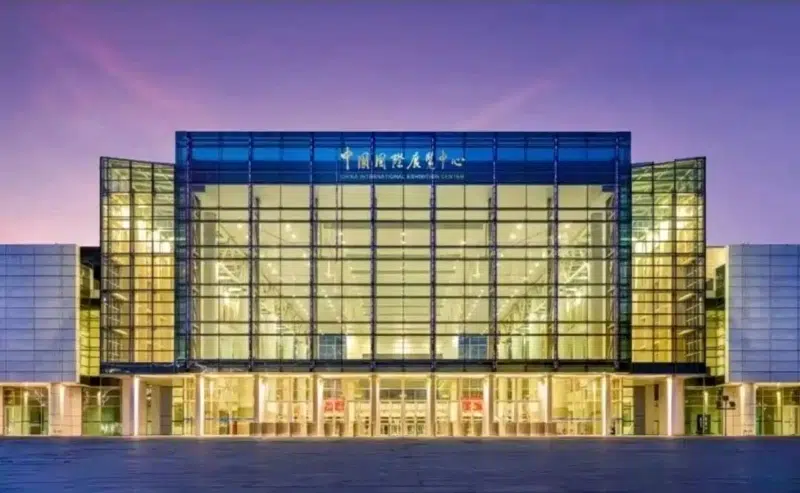
The 2026 edition will run from April 24 to May 3, spanning 10 days. For the first time, the event will adopt a dual-venue format, combining the China International Exhibition Centre (Shunyi Hall) and the Capital International Exhibition Centre. The two venues are adjacent, with a total layout stretching approximately 1.3 kilometres from north to south.
The exhibition schedule is divided into three phases. April 24–25 will serve as media days, followed by professional visitor days on April 26–27, and public days from April 28 to May 3. Visiting hours for professional and public audiences are set from 10:00 to 18:00.
1,451 vehicles, 181 debuts
According to official data, the show will feature 1,451 vehicles, including 181 world premieres and 71 concept cars. A total of 17 exhibition halls will be used, with 13 dedicated to complete vehicles.
The event will host a wide range of global and domestic automakers. International brands include BMW, Mercedes-Benz, Audi, Volkswagen, Toyota, and Ford, among others. Chinese automakers such as FAW Hongqi, Dongfeng Motor, Changan Automobile, Geely, and Great Wall Motor will also present their latest technologies and models.
Emerging, technology-focused brands, including Huawei-backed Harmony Intelligent Mobility, Nio, Xpeng, Li Auto, Xiaomi, and Leapmotor, are also expected to showcase developments across battery-electric, extended-range, and hydrogen powertrains.
BYD, along with its sub-brands Denza, Yangwang, and Fangchengbao, is expected to showcase new technologies and products at the Beijing Auto Show. The anticipated lineup may include Dynasty models such as the Great Tang, Han, and Qin Max, as well as Ocean series models such as the Seal 08 and Sealion 08. Fangchengbao could present the Ti 7 EV and a coupe-style F-series model, while Yangwang may display the U8L four-seat variant. Denza is expected to bring the Z9S and a possible X-series sports car. All model details remain subject to official confirmation.
Supplier and technology presence
Beyond automakers, the show will feature participants from 21 countries and regions across key supply chain and technology sectors. Exhibits will focus on electrification, intelligent driving systems, and digital vehicle architectures, reflecting ongoing industry transitions.
More than 200 press conferences are scheduled during the event, with participation from executives, researchers, policymakers, and global media.
Layout highlights
The newly released floor plan shows that both venues will host a mix of vehicle and component displays. The Capital International Exhibition Centre has the larger footprint, while the Shunyi venue continues to host major OEM booths.
Some automakers and technology groups are expected to occupy standalone or large-format booths, indicating expanded brand presence. The shift away from the older Jing’an Zhuang exhibition area marks a structural change in how the show organises suppliers and components.
Data context
China’s auto market provides the backdrop for the show’s scale. In 2025, total vehicle production and sales both exceeded 34 million units, maintaining the country’s position as the world’s largest auto market for the 17th consecutive year. New energy vehicles accounted for more than 50% of domestic new-car sales, while exports surpassed 7 million units, including 2.615 million NEVs
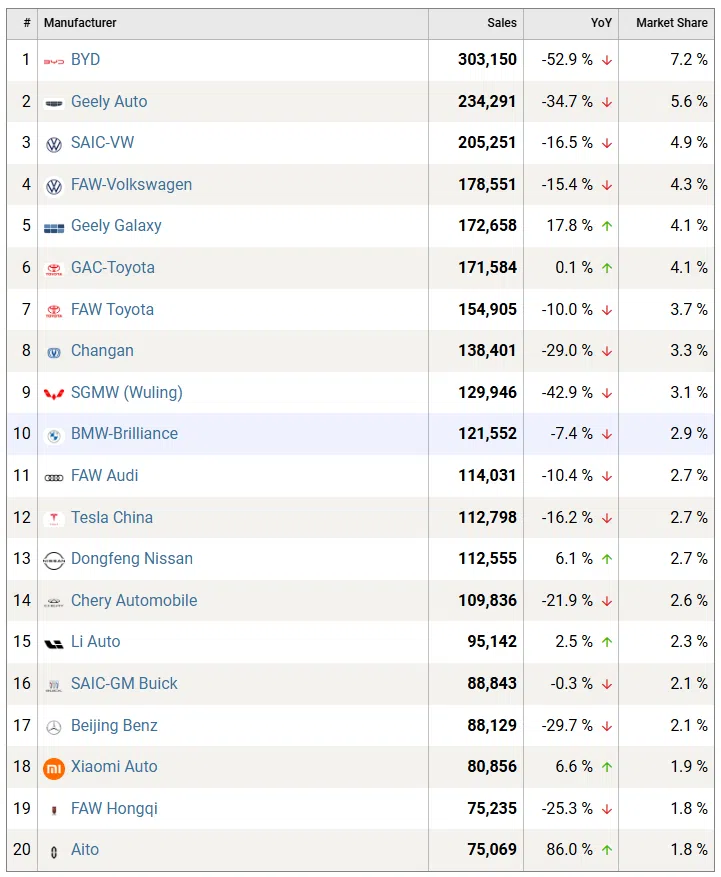
The latest 2026 domestic passenger vehicle retail data from China EV DataTracker shows BYD leading the market with 303,150 units, despite a 52.9% year-on-year decline, followed by Geely Auto at 234,291 units and SAIC-VW at 205,251 units. Joint-venture brands such as FAW-Volkswagen and GAC-Toyota remain in the top 10, though most show declining YoY performance.
In contrast, Geely Galaxy (+17.8%), Dongfeng Nissan (+6.1%), Li Auto (+2.5%), Xiaomi Auto (+6.6%), and Aito (+86.0%) posted growth, indicating continued momentum among select electrified and new-energy-focused brands. Tesla China recorded 112,798 units, down 16.2% YoY, while traditional premium joint ventures like BMW-Brilliance and Beijing Benz also declined. Overall, the dataset reflects a mixed market environment, where legacy joint ventures face pressure while newer NEV-focused brands and sub-brands show pockets of expansion.
Industry positioning
The 2026 Beijing Auto Show is positioned as a large-scale industry gathering reflecting ongoing shifts toward electrification, intelligent systems, and global competition. The expanded venue structure and increased exhibitor count highlight both domestic market scale and international participation.
The Beijing and Shanghai auto shows alternate on a biennial basis, with each hosting China’s primary international exhibition in its respective year.